2026 Stokes Family Office Quarter 3 Review
October 3, 2026



WHAT KEEPS US OPTIMISTIC
The S&P 500 finished the third quarter higher, but it was not an easy summer for investors. Borrowing costs climbed, energy became more expensive, and smaller companies lost ground. The headline index looked steadier than much of the market underneath it.
Yet the quarter also gave us a good reason to remain optimistic. Corporate earnings have grown, and investors are paying less for each dollar of expected profit than they were a year ago. That is a more encouraging development than a rally driven simply by a willingness to pay more.
Owning stocks means owning a share of businesses and their future earnings. It is worth remembering that when interest rates and daily headlines dominate the conversation. The question is whether those businesses can keep creating value over time.
THE INDEX DID NOT TELL THE WHOLE STORY
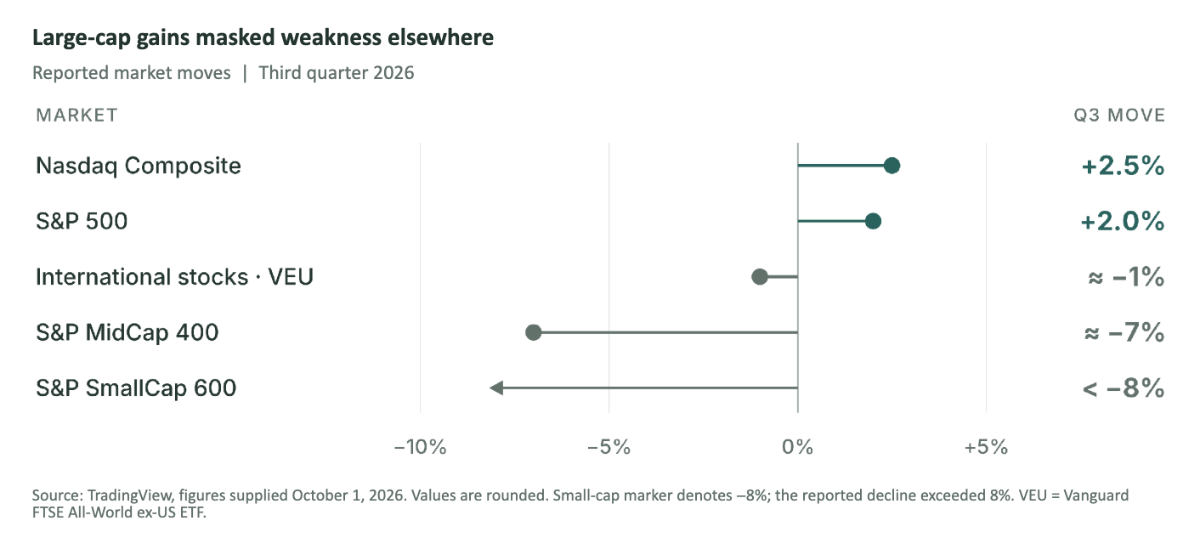
The S&P 500 gained 2.0% in Q3 and the Nasdaq Composite added 2.5%. The S&P MidCap 400 fell about 7%, however, and the S&P SmallCap 600 lost more than 8%. International equities also slipped, with the Vanguard FTSE All-World ex-US ETF down roughly 1% as the dollar strengthened.
The S&P 500 gives more weight to its largest companies, so their gains can offset weakness across much of the rest of the market. That is what narrowing market breadth means: fewer areas of the market are participating in the advance.
This is a quarter when diversification can test your patience. A portfolio that includes smaller companies and overseas stocks will not look like the S&P 500, and it should not be expected to. Those holdings serve a different purpose than matching the strongest part of the market each quarter.
The temptation is to own more of whatever has just worked. We prefer to ask whether the reasons for owning an investment have changed. A weak quarter can call for a closer look without calling for an exit. Spreading risk across businesses, markets and sources of return remains central to protecting what our clients have built.
HIGHER RATES CHANGE THE MATH
Much of the explanation for the quarter’s uneven returns came from the bond market. The 10-year Treasury yield rose from 4.42% at the end of June to 5.29% on September 30. A move of that size changes borrowing costs and the value investors place on future profits.
For a business refinancing debt or weighing an expansion, a higher rate can turn an attractive project into a marginal one. Smaller companies may have less flexibility to absorb the increase, as small and mid cap companies carry more debt than large caps, on average. It is one reason balance-sheet strength matters so much when financing gets more expensive.
For investors, there is another side to the story. Rising yields push down the price of existing bonds, but they also improve the interest available on new purchases. We need to consider both. A difficult period for bond prices can leave investors with better opportunities and outcomes for future returns in fixed income. A closely monitored and routinely rebalanced portfolio will add to bond positions when interest rates increase and prices go down.
Energy prices had a major impact in Q3. U.S. crude oil rose about 30% while Brent gained roughly 34%. Refining constraints and shipping costs added pressure beyond the price of crude. Families feel that at the pump and businesses through freight bills and operating expenses. If those costs stay elevated, inflation will be harder to bring down.
GROWTH HAS HELD UP
Even with those pressures, economic activity held up. At quarter-end, the Atlanta Fed’s GDPNow model put third-quarter growth at a 3.7% annualized rate. That was an estimate, not a reported GDP result. The initial August jobs report showed 162,000 jobs added and unemployment near 4.1%. Retail sales rose 1.2% for the month, before adjusting for inflation.
The harder part is inflation. August’s Personal Consumption Expenditures (PCE) price index rose 3.4% from a year earlier. Core PCE, which excludes food and energy, rose 3.0%. Both remained above the Fed’s 2% objective. Since quarter end, September jobs numbers and August jobs revisions have both come in lighter than anticipated. The stock and bond markets have received this news favorably, as it provides the Fed room to hold rates steady rather than be more restrictive with continued rate increases.
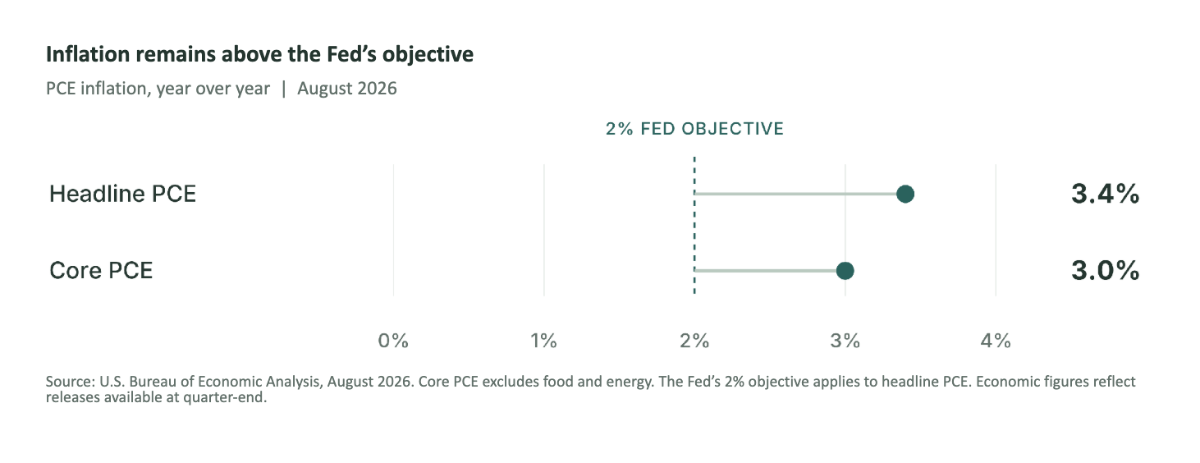
That combination leaves the Fed with little room for error. Stronger growth can help the economy absorb higher rates, but persistent inflation makes it harder to bring those rates down. We do not think a portfolio should depend on getting the timing of that decision exactly right.
There is also no contradiction between a growing economy and families feeling squeezed. Slower inflation does not undo the increases already built into everyday expenses. The evidence is more encouraging on growth than on the cost of living. Both deserve attention.
EARNINGS GIVE US A REASON TO LOOK AHEAD
Corporate earnings are the strongest reason for our optimism. Quarter-end estimates called for S&P 500 earnings-per-share growth of roughly 32% in 2026 and another 15% in 2027. The pace is expected to slow, but growth next year would come on top of a substantially larger profit base.
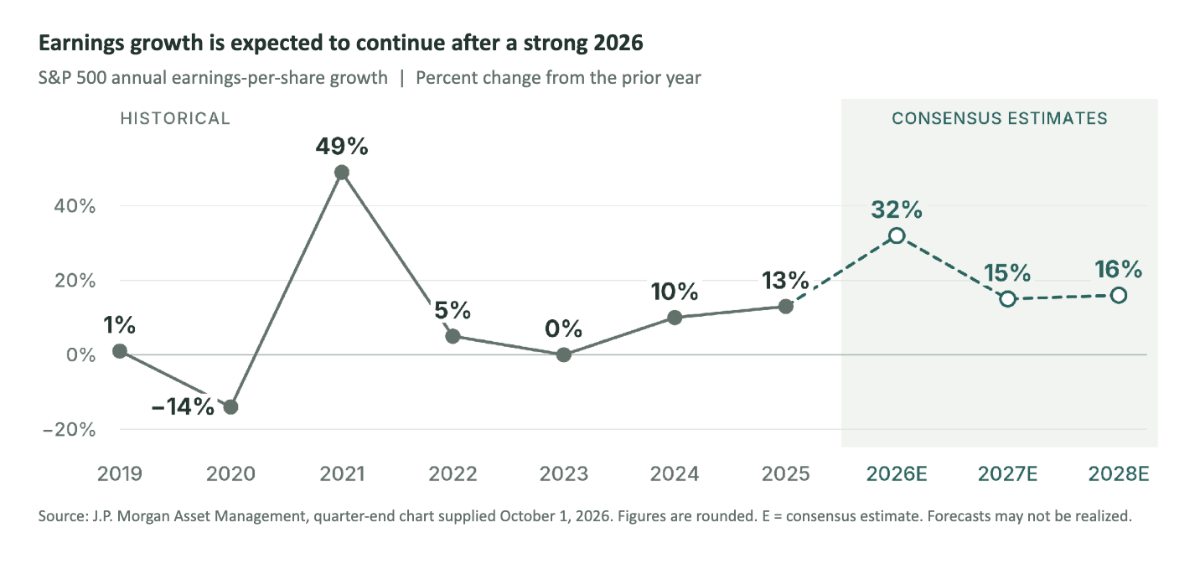
The improvement also matters for valuation. A year ago, the S&P 500 traded at about 23 times expected earnings; at quarter-end, it was closer to 19 times. Investors were paying less for each dollar of expected profit even though stocks had risen. With Treasury yields above 5%, that does not make equities an obvious bargain. It does mean earnings have done more of the work. Ultimately, in the long run, stock prices follow earnings. Strong earnings growth this year, and anticipated strong earnings growth in 2027 and 2028, will be a tailwind to stock market growth potential.
Some of this year’s profit gains are nonrecurring, and forecasts can change. In AI, the key question is whether today’s spending produces durable returns. NVIDIA’s forward price-to-earnings ratio has fallen as profit estimates have risen, but that lower multiple depends on those earnings materializing. We can be enthusiastic about what the technology may accomplish without assuming every investment in it will pay off.
THE BOTTOM LINE
We enter the fourth quarter focused on keeping near-term needs well funded and long-term capital invested across a range of opportunities. Any portfolio changes need to justify their risks and tax costs. We are not building a plan around the next election or Fed meeting, and we will not treat every market decline as a bargain.
Many of you have built businesses and made decisions that will benefit your families for years to come. We bring that same time horizon to investing. A quarter can change prices and create opportunities. It should not, on its own, dictate a plan meant to serve a family for decades.
Growing earnings give us a reason to look ahead with confidence. Our job is to put that progress to work in a way that supports the life you want to lead and the opportunities you want to create for your family. Thank you for the trust you place in us.

*Stokes Family Office does not offer legal or tax advice. Please consult the appropriate professional regarding your individual circumstances.